Physics
Physics
The Physics program at Solano Community College is dedicated to helping students explore and understand the fundamental laws that govern the universe.
Through hands-on laboratory experiments, critical problem-solving, and conceptual learning, students gain both a practical and theoretical foundation in physics that prepares them for transfer or entry into science and technology fields.
Discover the laws of the universe—start your physics journey at Solano!
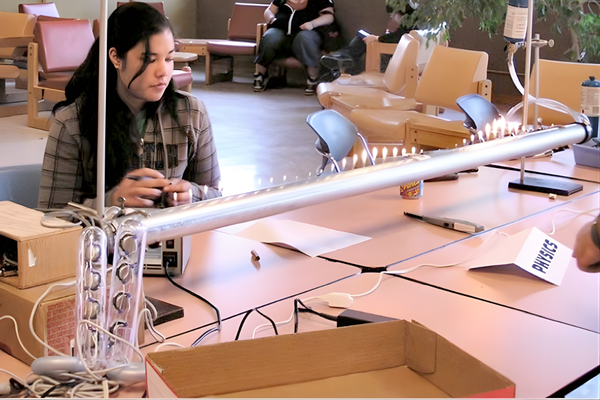
SCC student Caroline Parworth working on a “Rubens tube” which converts fluid pressure to gas flares, so that the height of the flare indicates the sinusoidal pressure distribution of the sound wave inside the tube. Caroline went on to obtain a PhD in Atmospheric Chemistry from UC Davis.
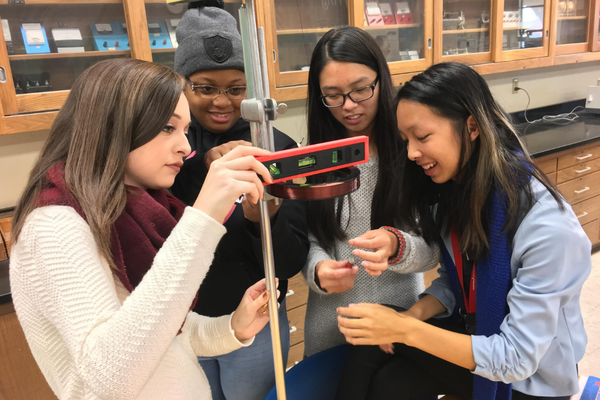
SCC students Alexandria Canales, Rhea Crawford, Brenda Lieu, Emily Wong (left to right), measuring the dipole moment of a permanent magnet in PHYS 007. Alexandria has since transferred to Sacramento State, Rhea has transferred to Cal State East Bay, Brenda has transferred to UC Irvine, and Emily has transferred to UC Davis.
The Physics program at Solano Community College emphasizes building a deep understanding and appreciation of the fundamental laws of the physical universe. Students strengthen their skills through conceptual learning, problem-solving, and laboratory investigations that connect theory to practice.
The program’s three-semester physics sequence (Physics 006, 007, 008) is designed for students pursuing majors in physics, chemistry, geology, engineering, and other physical sciences.
-
Physics 006 explores mechanics, gravitation, vibrations, and fluids.
-
Physics 007 covers electricity, magnetism, wave motion, and sound.
-
Physics 008 examines heat, optics, relativity, and modern physics.
Through these courses, students gain analytical and experimental skills that prepare them for upper-division coursework and future careers in science and technology.
-
Associate in Science in Physics for Transfer (AS‑T)
This transfer-focused degree is built for students planning to pursue a bachelor’s degree in Physics or a closely related field. It aligns with CSU general education standards and is designed to guarantee junior-level admission into the CSU system (though not to a specific campus or major). To earn the degree, students must complete 60 transferable semester units, including a 29-unit Physics major package, maintain a minimum GPA of 2.0, and earn a grade of C or better in required courses.
-
Associate in Science (A.S.) in Physics (non-transfer option)
This degree requires completion of a 35–39-unit Physics major, along with general education and elective coursework to meet the 60-unit requirement. It provides foundational skills for careers or further study in the sciences.
-
Physics Technician / Science Lab Technician
Assist in research labs, educational settings, or manufacturing environments—setting up experiments, monitoring processes, and analyzing results.
-
Engineering Support or Calibration Technician
Apply physics principles to support engineering teams, calibrate equipment, or serve in technical operations roles. Often an excellent entry into engineering pathways.
-
Data Analyst / Quantitative Modeler
Leverage analytical skills to interpret data and build models in finance, business, or research—physics grads are valued for their precision and quantitative thinking.
-
Research Assistant or Field Research Technician
Support scientific investigations in academia, government, or industry—especially in areas like environmental monitoring or instrumentation.
-
Health Physics or Radiation Safety Technician
Work in safety monitoring, radiation control, or exposure assessments in healthcare, industrial, or regulatory settings.
-
Technical or IT Analyst Roles
Take on roles such as software support or data-driven technical positions—physics grads often succeed in contexts for simulation, systems diagnostics, or IT support.
-
Pathway to Graduate Studies & Specialized Careers
Many physics graduates continue onto industries like aerospace, materials science, astrophysics, or engineering—often via graduate programs.