Astronomy
Astronomy
The Astronomy program at Solano Community College introduces students to the physical properties, behaviors, and processes that govern celestial bodies throughout the Universe. Students may take astronomy courses to fulfill natural science requirements or prepare for transfer to universities as majors in astronomy/astrophysics or as double majors in astronomy and physics.
From stargazing to space exploration, your journey into the Universe begins here.
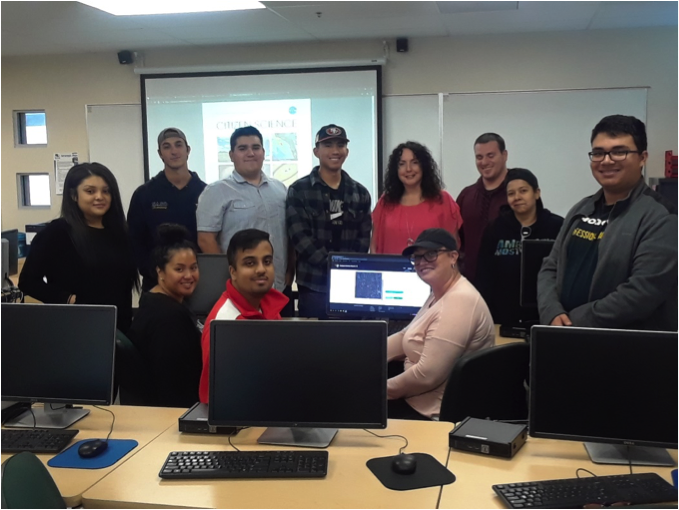
Dr. Maura Rabbette, standing fifth from the left, with her Astronomy students, working on a NASA Citizen Science research project. Solano students can participate in Citizen Science research by signing up for ASTR 049.
The program emphasizes strong preparation in physics and mathematics, since most advanced astronomy coursework is completed at the upper-division or graduate level. Introductory astronomy courses offered at Solano provide a foundation for exploring the major while building critical analytical and problem-solving skills.
Students planning to transfer should work closely with a counselor to determine additional coursework or specific electives required by their target transfer institution.
Graduates who pursue a B.S. in Astronomy may qualify for careers in teaching, planetarium operations, or observatory support roles. Advanced degrees (M.S. or Ph.D.) open pathways to teaching at the community college or university level, telescope operations, industry work, and careers in research with universities, observatories, or space agencies.
| Program | Degree Offered |
|---|---|
| Astronomy (AS Degree) | Yes – Associate in Science only |
| Certificate of Achievement | No certificate currently offered |
As part of a transfer-focused Astronomy curriculum grounded in physics and math, Solano students begin exploring the universe with opportunities that grow as they advance academically:
-
Planetarium Operator, Observatory Assistant, or Telescope Technician — Support operations and public programming at local planetariums and observatories.
-
High School or Science Educator — Teaching credentials and a B.S. in Astronomy position you to inspire the next generation of learners.
-
With an M.S., roles may include community college instructor, telescope operator, or positions in technical and observational support.
-
A Ph.D. opens doors to research and teaching careers in academia, or as a professional researcher at space agencies, research institutions, or observatories.
-
Research Assistant, Science Communicator, Technical Writer, or Science Journalist — Astronomy graduates often pursue writing and media roles that translate complex concepts for broad audiences.
-
Additional roles supported by astronomy training include data analyst, computational modeler, and instrumentation specialist, especially where physics and computer science blend with astronomical research.